
*Following subcutaneous administration.
FSH and LH
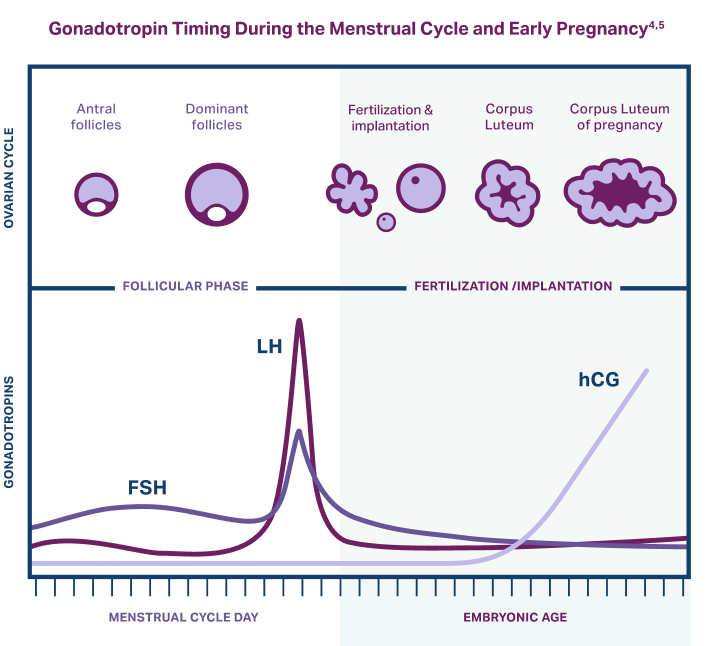
During the normal menstrual cycle, the precisely timed synergy of follicle-stimulating hormone (FSH) and luteinizing hormone (LH) orchestrates follicular development and maturation. These pituitary hormones also act in concert to coordinate the steroid production involved in development of the ovarian follicle.1
Human Chorionic Gonadotropin (hCG)
hCG comes into play at a later stage in the natural cycle than FSH and LH, as its production begins after fertilization and implantation.2 hCG stimulates production of progesterone by the corpus luteum, a vital step in the physiology of pregnancy.3
A curious connection:
LH and hCG
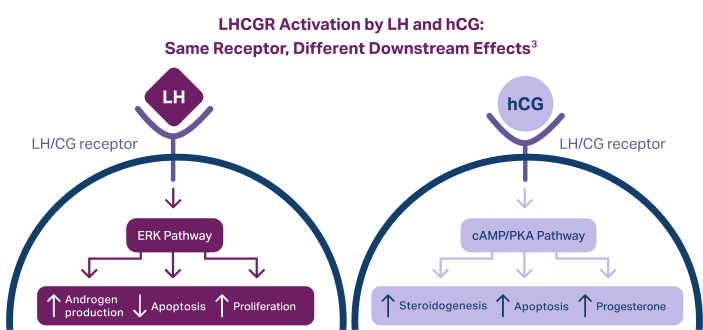
Researchers studying the evolution of human fertility have noted the interesting finding that LH and hCG have the same receptor (LHCGR: the luteinizing hormone choriogonadotropin receptor).6 However, the two hormones activate that receptor differently.3
Their different effects on the female reproductive tract make sense in the context of their distinct physiologic functions.3,6
Gonadotropins in the COS symphony
When managing controlled ovarian stimulation (COS) for intracytoplasmic sperm injection (ICSI) or in-vitro fertilization (IVF), clinicians orchestrate the finely tuned hormonal synergy required to support fertility. Hormones are administered, in urine-derived or recombinant forms, to stimulate ovarian follicle development.7 In this type of therapy, as in music, timing is key,8 so the duration of action of these hormones has relevance. The pharmacokinetics of LH, FSH, and hCG differ between the endogenous hormones, and exogenous, therapeutic forms.
Gonadotropin Half-Lives
LH
Endogenous 25-90 mins6
Exogenous* 21-24 hrs9
The pituitary gland releases LH in a pulsatile manner.10 Increased and sustained release occurs mid-cycle, during the LH surge.6,11 LH, in concert with FSH, supports oocyte growth and maturation, and stimulates ovarian steroid production.1 While LH is not currently available for use in COS in the United States, LH-like activity can be provided by hCG.12
FSH
Endogenous 2-17 hrs13
Exogenous* 37 hrs14,15
The role of FSH in COS mirrors its activity in the natural fertility cycle. As the name implies, it stimulates follicular growth and maturation.1,16 FSH also converts androgens to estradiol within the ovarian follicle.17 Like LH, FSH has a pulsatile pattern of pituitary release.10 The half-life of the recombinant form, administered subcutaneously, is considerably longer.
hCG
Endogenous 24-36 hrs18
Exogenous* 37-39 hrs19
In the natural fertility process, endogenous hCG is produced after fertilization and implantation. Exogenous hCG has a role in fertility treatment because it possesses LH-like activity.2 It has two main uses: (1) to provide a synergistic effect with FSH in supporting follicular growth and maturation, and (2) to mimic the LH-surge as a means of triggering ovulation.2,12


1. Bosch E et al. Hum Reprod. 2021;36(6):1469-80. 2. Theofanakis C et al. Int J Mol Sci. 2017;18:1059 (1-8). 3. Choi J et al. Mol Cell Endocrin. 2014;383:23-213. 4. Reed BG et al. The normal menstrual cycle and the control of ovulation. NCBI Bookshelf. Updated 2018. 5. Han X et al. PLOSOne. 2018;13(9): e0203610. 6. Casarini L et al. Endo Rev. 2018;39:549-592. 7. ESHRE Guideline Group on Ovarian Stimulation. Human Repro. 2026; 41(4):498-514. 8. Racca A et al. Drugs. 2020;doi.org/10.1007/s40265-013245-w (1-22). 9. Ezcurra D et al. Reprod Bio Endo. 2014;12:95. 10. Zikopoulos A et al. Biomed. 2026;14:789 (1-23). 11. Direito A et al. Fertil Steril. 2013;99(1):279-285. 12. Capolupo A et al. Int J Mol Sci. 2024;25:9405. 13. Wide L et al. J Clin Endo Metab. 2022;107:e4058-e4062. 14. Le Cotonnec Y-V et al. Fertil Steril. 1994;61(4):679-686. 15. Cai Y-M et al. Asian J Pharmacodyn Pharmacokinet. 2009;9(4):269-276. 16. Bergandi L et al. Pharmaceuticals. 2020;13:136.17. Longo M et al. Reprod Bio Endo. 2025;23(Suppl1):22 (1-9). 18. Mayo Clinic Laboratories: Neurology Catalog. 19. Radicioni M et al. Clin Drug Invest. 2022;42:199-206.

The information on this site is intended for US healthcare professionals only and is governed by US laws and government regulations.
© 2026 Merck KGaA, Darmstadt, Germany or its affiliates. All rights reserved. EMD Serono is the healthcare business of Merck KGaA, Darmstadt, Germany in the U.S. and Canada.
Use and access of this site are subject to the terms and conditions set out in our Legal Statement and Privacy Policy
US-NONF-00815 05/26